<?xml version="1.0" encoding="utf-8"?><feed xmlns="http://www.w3.org/2005/Atom" xml:lang="en_US"><generator uri="https://jekyllrb.com/" version="3.10.0">Jekyll</generator><link href="https://nabajitb.github.io/feed/blogs.xml" rel="self" type="application/atom+xml" /><link href="https://nabajitb.github.io/" rel="alternate" type="text/html" hreflang="en_US" /><updated>2026-11-01T13:03:26+00:00</updated><id>https://nabajitb.github.io/feed/blogs.xml</id><title type="html">Nabajit Borah | Blogs</title><subtitle>Computational biologist working at the intersection of AI and protein structure.</subtitle><author><name>Nabajit Borah</name></author><entry><title type="html">Bennu’s Bakery: Ribose, Polymers, and Stardust from an Asteroid</title><link href="https://nabajitb.github.io/blogs/bennus-bakery-ribose-polymers-and-stardust-from-an-asteroid/" rel="alternate" type="text/html" title="Bennu’s Bakery: Ribose, Polymers, and Stardust from an Asteroid" /><published>2025-12-03T14:56:46+00:00</published><updated>2025-12-03T14:56:46+00:00</updated><id>https://nabajitb.github.io/blogs/bennus-bakery-ribose-polymers-and-stardust-from-an-asteroid</id><content type="html" xml:base="https://nabajitb.github.io/blogs/bennus-bakery-ribose-polymers-and-stardust-from-an-asteroid/"><![CDATA[<h2 id="a-napkin-a-bar-and-a-plan-to-invade-a-space-asteroid">A napkin, a bar, and a plan to invade a space asteroid</h2>
<p>The origin of NASA’s OSIRIS-REx spacecraft mission was born in 2004, when two planetary scientists and an engineer sat in a Tucson bar, a short walk from the University of Arizona campus. Michael Drake, who had spent a career thinking about “Did asteroids seed early Earth with the molecules needed to start biology?” while he sat across young Dante Lauretta and Lockheed Martin engineer Steve Price.</p>
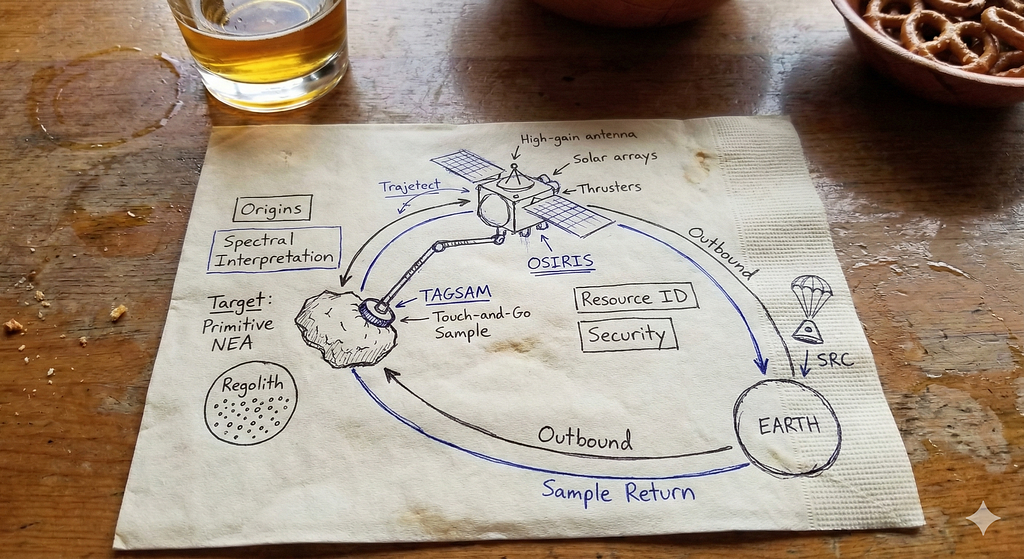
<p>On that cocktail napkin, the three sketched the mission concept Drake wanted to pitch to NASA. Lauretta gave it the name <strong>OSIRIS (Origins, Spectral Interpretation, Resource Identification, and Security).</strong> The first attempt failed immediately. Reviewers dismissed it as they haven’t yet identified a specific asteroid to target. They reworked the plan, only to be rejected again, this time for being too ambitious and too expensive.</p>
<figure><img loading="lazy" alt="" src="/assets/images/blogs/bennus-bakery-ribose-polymers-and-stardust-from-an-asteroid/1.png" /><figcaption>A hypothetical visualization of the napkin sketch</figcaption></figure>
<p>Instead of shrinking the idea, they expanded it. The mission grew in scope and in name. OSIRIS became <strong>OSIRIS-REx, with “Regolith Explorer”.</strong> A regolith is the loose, dusty mix of gravel, powder, and shattered rock found on the surface of an asteroid. The mission no longer aimed to just study an asteroid from orbit. It committed to penetrating the surface environment, characterizing the mineralogy, mapping the chemistry with high-precision instruments and extracting a physical sample of primitive regolith for return to Earth. In 2011, after years of work, NASA finally said yes.</p>
<h2 id="why-bother-spending-a-billion-dollars-to-grab-a-handful-of-a">Why bother spending a billion dollars to grab a handful of asteroid dust when thousands of meteorites fall to Earth every day?</h2>
<p>The famous Murchison meteorite that fell in Australia in 1969, carried more than seventy amino acids, but it was contaminated by atmospheric entry heating, weathering, and exposure to terrestrial microbes, making it impossible to know with certainty which molecules were truly extraterrestrial. Therefore, the only was to fly to a primitive asteroid, scoop untouched material, and bring it home before Earth touched it.</p>
<h2 id="but-why-bennu-became-the-chosen-one">But why Bennu became the chosen one?</h2>
<ul><li><strong>Proximity and accessibility :</strong>The mission required an asteroid whose orbit closely matched Earth’s low eccentricity and inclination to minimize fuel costs and travel time. At the time of selection in 2008, only <strong>192 of approximately 7,000 known near-Earth objects</strong> met these orbital criteria.</li><li><strong>Size and rotation: </strong>Asteroids smaller than 200 meters diameter spin so rapidly they throw their regolith into space, leaving no surface material to sample. This requirement reduced candidates from 192 to just <strong>26 asteroids.</strong></li><li><strong>Composition: </strong>Primitive, carbon-rich asteroids that have barely changed since the Solar System formed 4.5 billion years ago. These B- and C-type bodies are the ones loaded with organics, volatiles, and amino acids. Of the 26 remaining candidates, only <strong>12 had known compositions, and only 5 were primitive and carbon-rich</strong>.</li></ul>
<p>Asteroid (101955) <strong>Bennu</strong> was the final choice. Discovered in 1999 by the Lincoln Near-Earth Asteroid Research (LINEAR) survey, it’s a 490-meter rubble pile that revolves around the Sun every 436 days and passes near Earth every six years. Also, it has a small but real chance of hitting Earth on September 24, 2182 (roughly 1 in 2,700 odds).</p>
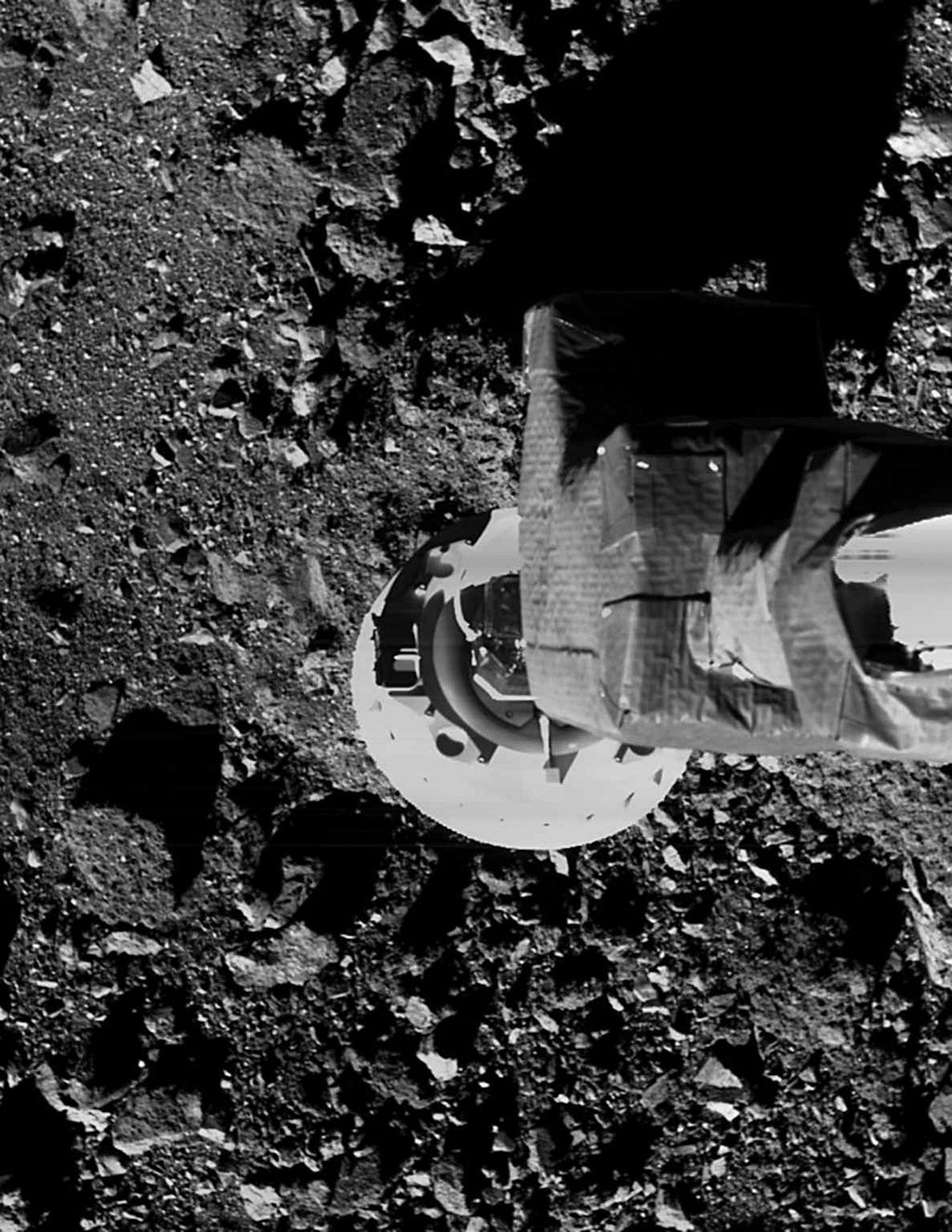
<figure><img loading="lazy" alt="" src="/assets/images/blogs/bennus-bakery-ribose-polymers-and-stardust-from-an-asteroid/2.png" /><figcaption>Asteroid Bennu during OSIRIS-REx sample</figcaption></figure>
<h2 id="the-journey-seven-years-to-touch-an-asteroid">The Journey: Seven Years to Touch an Asteroid</h2>
<p>OSIRIS-REx launched from Cape Canaveral on <strong>September 8, 2016</strong>, aboard an Atlas V rocket and arrived at Bennu on <strong>December 3, 2018.</strong></p>
<p>Bennu looked nothing like the pre-launch models. Instead of smooth sands, the asteroid was full of huge rocks and boulders, everywhere. Bennu was actively ejecting particles into space and the asteroid’s surface was so loosely packed, it was a quicksand so landing wasn’t an option so the team used a device called <strong>TAGSAM </strong>(<strong>Touch-and-Go Sample Acquisition Mechanism), a 11-foot arm with a circular collection head that would contact the asteroid surface, release high-pressure nitrogen gas to fluidize loose material, and capture regolith instantly.</strong></p>
<iframe src="https://cdn.embedly.com/widgets/media.html?src=https%3A%2F%2Fwww.youtube.com%2Fembed%2FKan0FIjjjQw%3Ffeature%3Doembed&amp;display_name=YouTube&amp;url=https%3A%2F%2Fwww.youtube.com%2Fwatch%3Fv%3DKan0FIjjjQw&amp;image=https%3A%2F%2Fi.ytimg.com%2Fvi%2FKan0FIjjjQw%2Fhqdefault.jpg&amp;type=text%2Fhtml&amp;schema=youtube" width="854" height="480" frameborder="0" scrolling="no"><a href="https://medium.com/media/cbb8691c3a5947524660c576a14d332a/href">https://medium.com/media/cbb8691c3a5947524660c576a14d332a/href</a></iframe>
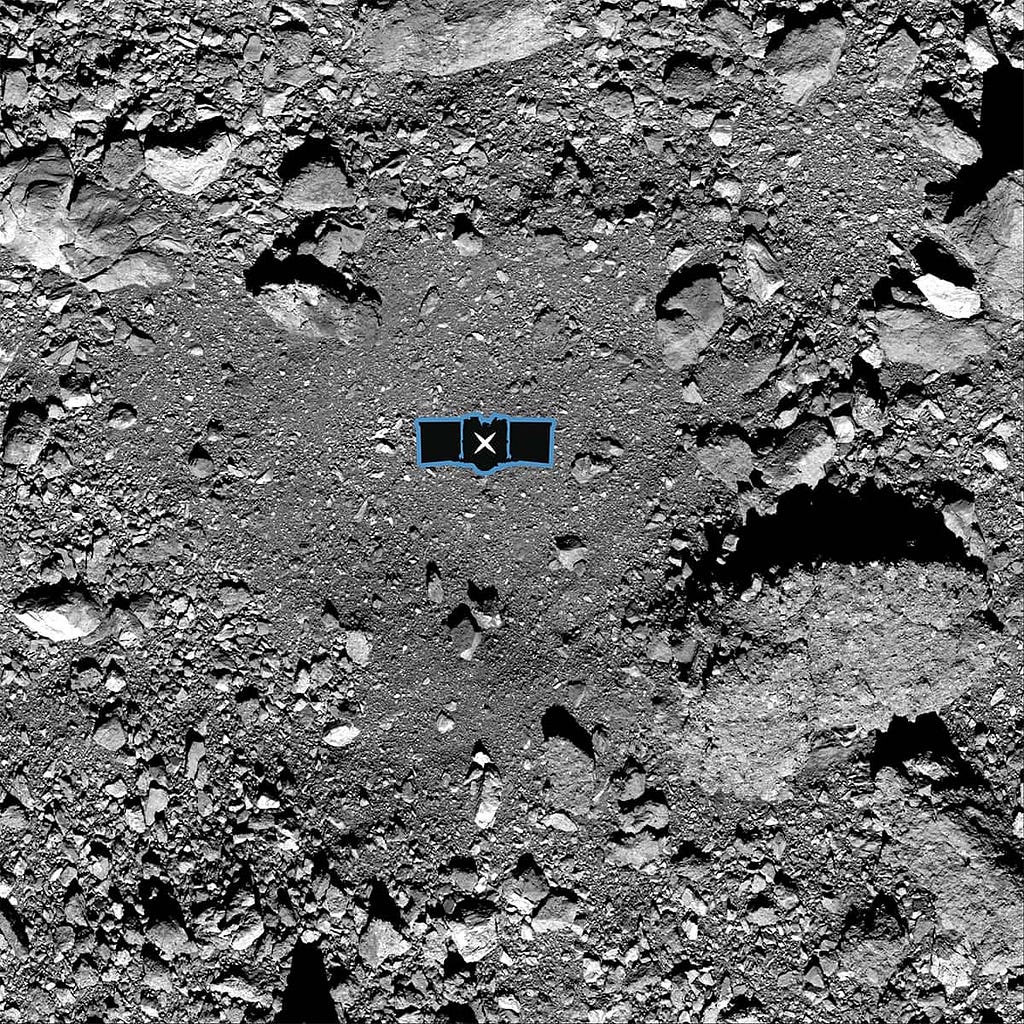
<p>On <strong>October 20, 2020</strong>, after nearly two years of surface mapping of the asteroid, the spacecraft touched Bennu for only <strong>five seconds,</strong> just long enough to fire its nitrogen burst and collect regolith before thrusting away.</p>
<figure><img loading="lazy" alt="" src="/assets/images/blogs/bennus-bakery-ribose-polymers-and-stardust-from-an-asteroid/3.png" /><figcaption>NASA’s OSIRIS-REx Successfully Touches Asteroid Bennu</figcaption></figure>
<p>The return capsule landed in Utah on 24 September 2023 with <strong>121.6 grams</strong> of asteroid dust, the largest extraterrestrial sample returned since the Apollo missions.</p>
<h2 id="the-chemistry-of-stardust">The Chemistry of Stardust</h2>
<p>From one 603-mg portion of homogenized Bennu powder, researchers lead by <strong>Yoshihiro Furukawa</strong> at Tohoku University began the slow extraction of organics.</p>
<p>The extraction protocol was carefully designed to prevent sugar formation or degradation during analysis. The team used <strong>2% HCl acid extraction</strong> because sugar-forming reactions are suppressed at low pH. The extracted material underwent:</p>
<ol><li><strong>Sonication extraction</strong> in acid solution (30 minutes, under 25°C)</li><li><strong>Water extraction</strong> of residues</li><li><strong>Methanol purification</strong></li><li><strong>Cation exchange chromatography</strong> to remove interfering ions</li><li><strong>Derivatization</strong> into aldonitrile acetates (chemically modified forms easier to detect via gas chromatography)</li></ol>
<p>Gas chromatography–tandem mass spectrometry (GC-MS/MS) was the core tool. The asteroid dust were vaporized, pushed through a chromatography column, and separated by how fast they moved, each one has its own retention time. As they exited the column, the mass spectrometer shattered them into fragments. The resulting <strong>mass-to-charge (m/z) ratios</strong> create a unique “fingerprint” for each compound.</p>
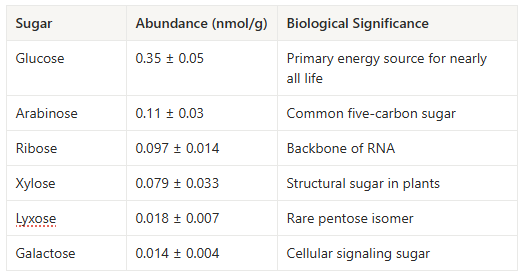
<p>For pentose sugars, the team monitored five characteristic fragment masses. For hexose sugars, they monitored six fragments. That’s how ribose, glucose, arabinose, xylose, lyxose, and galactose were confirmed in Bennu. <strong>One sugar was conspicuously absent: 2-deoxyribose, the backbone of DNA.</strong> Its absence makes chemical sense. Deoxyribose is chemically fragile; it would have been rapidly consumed by reactions with other molecules during the asteroid’s 4.5-billion-year history.</p>
<figure><img loading="lazy" alt="" src="/assets/images/blogs/bennus-bakery-ribose-polymers-and-stardust-from-an-asteroid/4.png" /><figcaption>The table shows Abundance of Sugars Detected in Bennu Samples</figcaption></figure>
<p>Bennu sample analysis found all five canonical nucleobases (adenine, guanine, cytosine, thymine, and uracil), phosphates, and 14 amino acids i.e. <strong>Bennu carried the ingredients for RNA, not DNA.</strong></p>
<h2 id="how-did-sugars-originate-in-an-asteroid">How did sugars originate in an asteroid?</h2>
<p>The leading hypothesis involves the formose reaction, a chemical process first described by Russian chemist Alexander Butlerov in 1861.</p>
<p>In this reaction, formaldehyde (CH₂O) molecules undergo sequential addition reactions:</p>
<pre>2 CH2O → C2H4O2 (glycolaldehyde)<br /><br />C2H4O2 + CH2O → C3H6O3 (glyceraldehyde)</pre>
<p>This process continues iteratively, building larger sugars from smaller ones. The reaction becomes <strong>autocatalytic</strong>; products of the reaction catalyze further reactions, accelerating sugar formation.</p>
<p>Evidence for formose-style sugar formation inside Bennu’s parent body is strong:</p>
<p>• <strong>Aldehydes present:</strong> Formaldehyde and related precursors were detected.<br /> • <strong>Alkaline conditions:</strong> Bennu extracts show pH ~8.2, ideal for formose chemistry.<br /> • <strong>Catalysts available:</strong> Calcium and magnesium carbonates promote sugar formation, Bennu contains abundant of it.<br /> • <strong>Water-rock interaction:</strong> Phyllosilicates indicate Bennu’s parent body experienced a lot of water-rock interactions.<br /> • <strong>Sugar patterns match:</strong> Bennu’s pentose distribution mirrors lab formose products.</p>
<h2 id="supporting-the-rna-world-hypothesis">Supporting the RNA World Hypothesis</h2>
<p>Life first relied on RNA. Unlike DNA, RNA can both <strong>store genetic information</strong> and <strong>catalyze chemical reactions</strong> (as ribozymes) even before proteins were evolved.</p>
<p>The Bennu findings support this in several ways:</p>
<ul><li><strong>Ribose present, deoxyribose absent</strong>: The building block of RNA was available; the building block of DNA was not</li><li><strong>All five nucleobases detected</strong>: The complete genetic alphabet for both RNA and DNA exists in Bennu</li><li><strong>Widespread distribution</strong>: If Bennu is representative of carbonaceous asteroids, these molecules were common throughout the early solar system</li></ul>
<h2 id="space-gum-and-stardust">“Space Gum” and “Stardust”</h2>
<p>A team of NASA Ames discovered a <strong>gum-like polymer material</strong> never before seen in astromaterials. A nitrogen- and oxygen-rich polymer, originally flexible but now hardened, formed through <strong>carbamate polymerization</strong> when ammonia and carbon dioxide reacted on hot Bennu’s surface. This could be a chemical precursors for life’s emergence</p>
<p>Secondly, another team at NASA Johnson Space Center found that Bennu samples contain <strong>six times more supernova dust</strong> than any previously studied astromaterial. This suggest that <strong>Bennu’s parent is older than the solar system itself.</strong></p>
<h2 id="the-story-isn-t-over">The story isn’t over</h2>
<p>Only a fraction of the 121.6 grams has been analyzed so far. NASA curators are distributing portions to laboratories worldwide, and the majority of the sample is being preserved for future generations until better instruments exist.</p>
<p>Meanwhile, the spacecraft itself continues exploring. Renamed <strong>OSIRIS-APEX</strong>, it’s now en route to asteroid <strong>(99942) Apophis</strong>, which will make an exceptionally close Earth flyby in 2029. Scientists hope to study how gravitational tides from that close approach affect the asteroid’s surface</p>
<p>if you love reading about biotech x AI, follow me on twitter/X <a href="https://x.com/TensorTwerker">@TensorTwerker</a> : I share insights on protein modeling, computational biology, and the occasional chaos that happens in my life.</p>]]></content><author><name>Nabajit Borah</name></author><category term="bio-essential-sugars" /><category term="osiris-rex" /><category term="asteroids" /><category term="bennu" /><category term="nasa" /><summary type="html"><![CDATA[The origin of NASA’s OSIRIS-REx spacecraft mission was born in 2004, when two planetary scientists and an engineer sat in a Tucson bar, a short walk from the University of Arizona campus. Michael Drake, who had spent a…]]></summary><media:thumbnail xmlns:media="http://search.yahoo.com/mrss/" url="https://nabajitb.github.io/assets/images/blogs/bennus-bakery-ribose-polymers-and-stardust-from-an-asteroid/1.png" /><media:content medium="image" url="https://nabajitb.github.io/assets/images/blogs/bennus-bakery-ribose-polymers-and-stardust-from-an-asteroid/1.png" xmlns:media="http://search.yahoo.com/mrss/" /></entry><entry><title type="html">BoltzGen: from a Biologist’s Perspective</title><link href="https://nabajitb.github.io/blogs/boltzgen-from-a-biologists-perspective/" rel="alternate" type="text/html" title="BoltzGen: from a Biologist’s Perspective" /><published>2025-12-02T17:22:52+00:00</published><updated>2025-12-02T17:22:52+00:00</updated><id>https://nabajitb.github.io/blogs/boltzgen-from-a-biologists-perspective</id><content type="html" xml:base="https://nabajitb.github.io/blogs/boltzgen-from-a-biologists-perspective/"><![CDATA[<figure><img loading="lazy" alt="" src="/assets/images/blogs/boltzgen-from-a-biologists-perspective/1.png" /></figure>
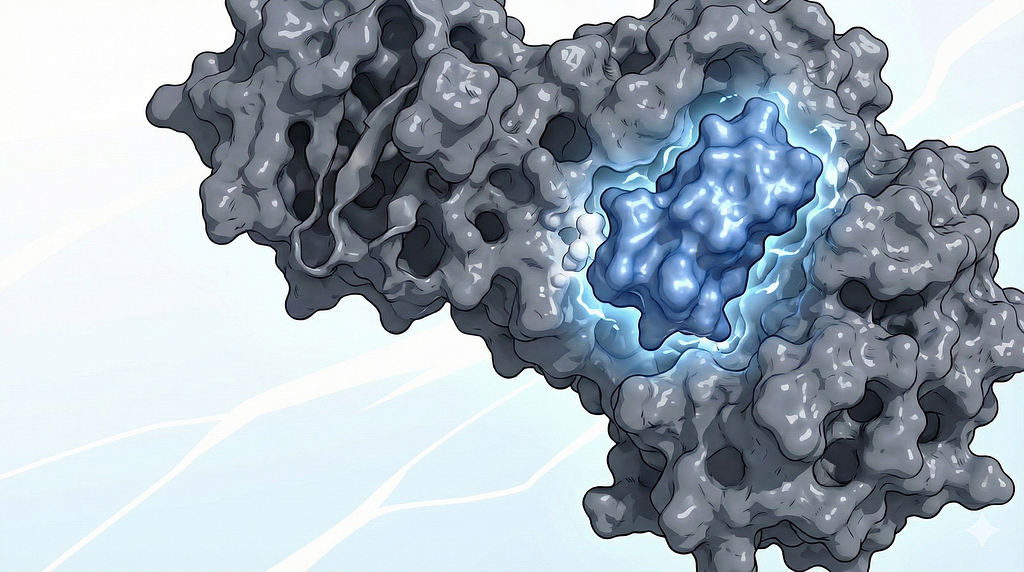
<p><strong>BoltzGen</strong>, a new diffusion model that generates <em>de novo </em>molecules from scratch which binds to other proteins, peptides, nanobodies, disulfide-cyclized peptides, helicons, cyclic peptides, and protein binders for small molecules, nucleic acids, disordered regions, and folded protein targets. That’s why it’s called an <strong>universal binder</strong>. It consists of:</p>
<ul><li><strong>BoltzGen</strong> (the diffusion model which generates <em>de novo</em> structures)</li><li><strong>BoltzIF</strong> (for inverse folding, <em>given this fold, what sequence would actually stabilize it?)</em></li><li><strong>Boltz-2</strong> it refolds the designed sequence, checks whether the structure holds together, estimates binding affinity, and evaluates interface quality through buried surface area, hydrogen bonds etc.)</li></ul>
<p>BoltzGen doesn’t treat proteins as tokens like Large Language Models. It treats them as physical objects that only make sense in three dimensions as amino acid residues are in certain order and folded in 3D space.</p>
<p><strong>So how did they solve it?</strong></p>
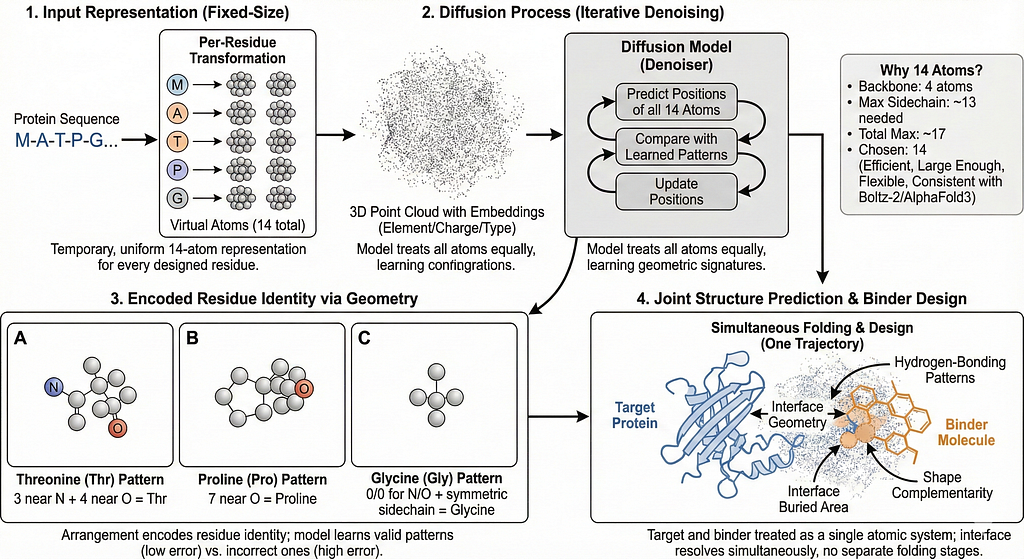
<h2 id="14-atoms-representation">14 atoms representation</h2>
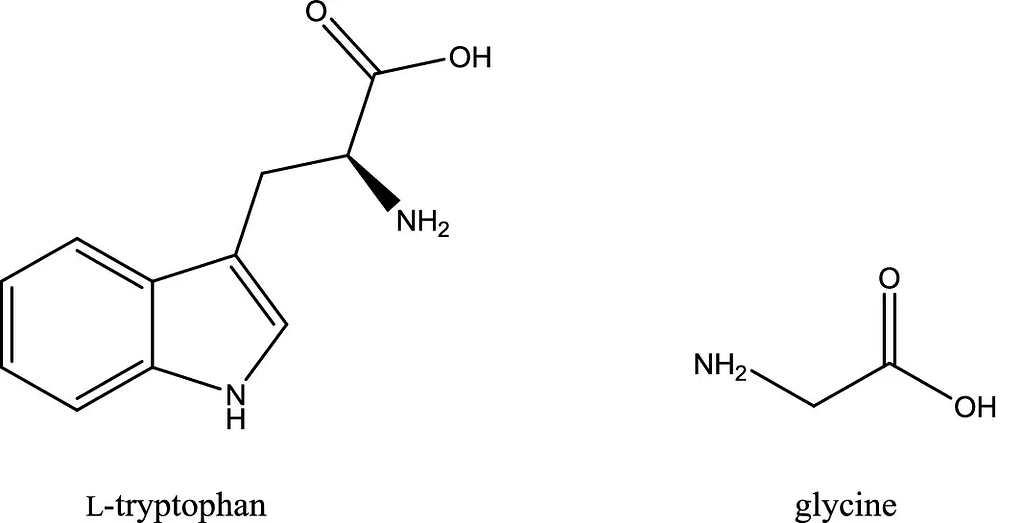
<p>Amino acids has different size and shapes. Glycine barely has a sidechain at all. Tryptophan has a large aromatic component. Diffusion models don’t like that chaos.</p>
<figure><img loading="lazy" alt="" src="/assets/images/blogs/boltzgen-from-a-biologists-perspective/2.png" /></figure>
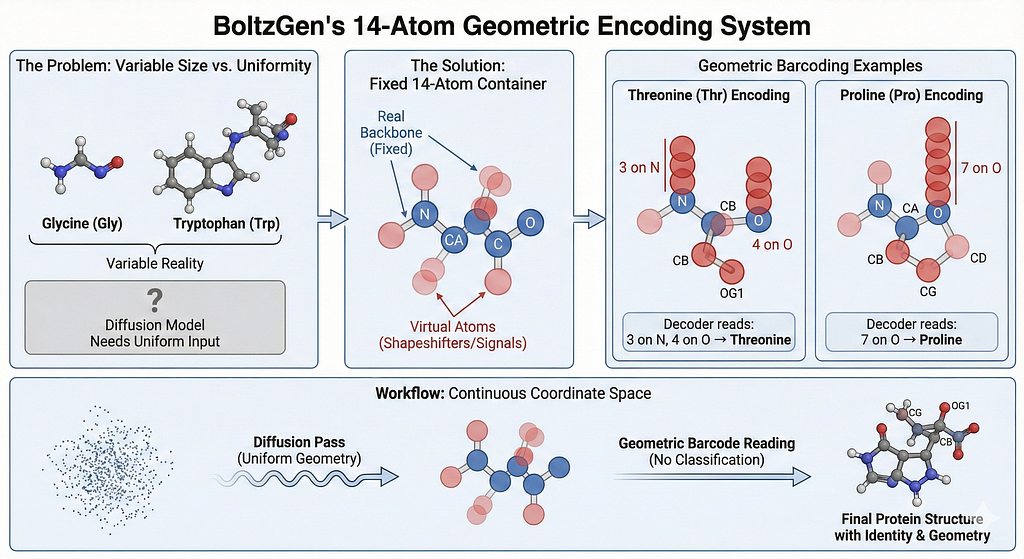
<p>When BoltzGen is <em>designing</em> a residue, it doesn’t yet know whether that position will become an Alanine or a Threonine. Each amino acid has a different number of atoms, from 1–20 atoms on its sidechain. <strong>That’s the problem, the model needs a fixed-size structure</strong> (same number of atoms every time), otherwise you can’t diffuse coordinates in a consistent vector space.</p>
<p><strong>BoltzGen’s solution:</strong></p>
<p>Each designed residue is temporarily represented using <strong>exactly 14 atoms</strong>, regardless of which amino acid it will eventually become.</p>
<ul><li>4 atoms are <em>real</em> backbone atoms: <strong>N, CA, C, O</strong></li><li>The remaining <strong>10 atoms are “virtual” placeholders</strong>. The model signals which amino acid it wants by placing a specific number of these virtual atoms directly onto the backbone atoms (on top of <strong>N</strong> and <strong>O</strong>). Then it decode the amino acid identity by counting how many virtual atoms land on each backbone position (within 0.5 Å).</li></ul>
<p>After generation finishes:</p>
<ul><li>virtual atoms are discarded</li><li>a real amino acid identity is decoded from their positions</li></ul>
<figure><img loading="lazy" alt="" src="/assets/images/blogs/boltzgen-from-a-biologists-perspective/3.png" /></figure>
<h2 id="how-the-model-actually-turns-the-14-atom-placeholder-into-th"><strong>How the model actually turns the 14-atom placeholder into the final real amino acid geometry?</strong></h2>
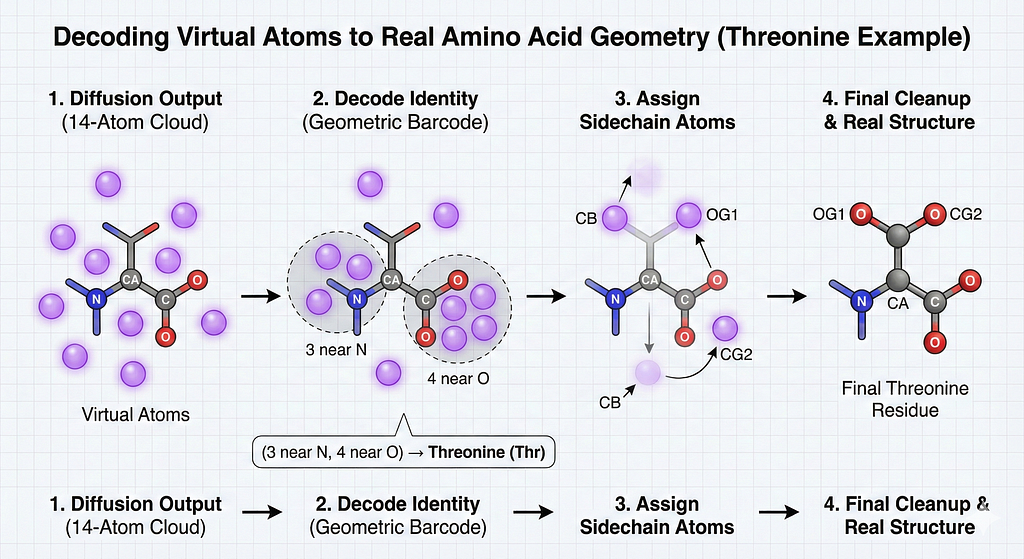
<p>Diffusion is a cloud, once the model finish diffusion, it has 14 residues as I have mentioned earlier. The system has to translate that cloud into: a real amino acid with a real sidechain which doesn’t break chemistry. Let’s understand this with Threonine example:</p>
<p>Each amino acid has a unique pattern like a barcode. Threonine is encoded by placing <strong>3</strong> virtual atoms on the <strong>backbone nitrogen</strong>, and <strong>4</strong> virtual atoms on the <strong>backbone oxygen</strong>.</p>
<ul><li>Fixed atoms (backbone) which always exists: N,CA, C, O</li><li>Virtual atoms (atoms 5–14)</li><li>BoltzGen needs to signal the residue identity using atoms 5–14</li></ul>
<p>So the threonine encoding looks like:</p>
<pre>N atom:   N + 3 virtual atoms<br />CA atom:  (just CA)<br />C atom:   (just C)<br />O atom:   O + 4 virtual atoms<br />Sidechain: 3 atoms left → CB, OG1, CG2</pre>
<p>For threonine, check how many virtual atoms are within 0.5 Å of:</p>
<ul><li><strong>3 virtual atoms placed exactly on top of the N atom</strong></li><li><strong>4 virtual atoms placed exactly on top of the O atom</strong></li><li><strong>Remaining 3 virtual atoms</strong> become real sidechain atoms (CB, OG1, CG2) where CB = beta carbon; OG1 = hydroxyl oxygen branch; CG2 = second carbon branch of threonine’s side chain.</li></ul>
<figure><img loading="lazy" alt="" src="/assets/images/blogs/boltzgen-from-a-biologists-perspective/4.png" /></figure>
<p>Diffusion doesn’t guarantee perfect bond lengths or ideal chirality, so the model runs a local cleanup pass where bonds are corrected, angles restored to restore chemistry.</p>
<h2 id="how-the-diffusion-process-works"><strong>How the Diffusion Process Works?</strong></h2>
<p>Diffusion models can only operate on <strong>fixed-size representations</strong>. As I have discussed above, BoltzGen solves this by giving every <em>designed</em> residue a temporary, uniform 14-atom representation.</p>
<p><strong>Diffusion treats all atoms equally i.e.</strong> the diffusion model sees just a cloud of 3D points with element/charge/type embeddings. It doesn’t know which atoms are virtual; that’s only used in decoding afterward. With iterative denoising:</p>
<ul><li>the denoiser predicts the positions of all 14 atoms</li><li>their arrangement will encode residue identity via geometry</li><li>the denoiser learns the patterns that correspond to valid amino acids</li></ul>
<h2 id="why-virtual-atoms-encode-residue-identity-so-effectively">Why virtual atoms encode residue identity so effectively?</h2>
<p>During training, the model repeatedly encounters the same geometric signatures that distinguish one amino acid from another.</p>
<ul><li><strong>“3 near N + 4 near O = Threonine”</strong></li><li><strong>“7 near O = Proline”</strong></li><li><strong>“0/0 for N/O + symmetric sidechain = Glycine”</strong></li></ul>
<p>These configurations repeatedly appear in real proteins. The diffusion model learns that reproducing them reduces structural error, incorrect patterns (wrong amino acids) increase the <strong>Mean Squared Error (</strong>MSE) and <strong>local Distance Difference Test (</strong>lDDT) errors. As a result, it naturally produces these patterns during generation.</p>
<h2 id="but-why-14-atoms-why-not-10-or-20">But why 14 atoms? Why not 10 or 20?</h2>
<p>Simply, to support the largest residues without running out of space, you need:</p>
<pre>Backbone: 4 atoms<br />Max sidechain atoms needed: 13<br />Total theoretical max = 17</pre>
<p>Thus <strong>14 atoms</strong> is:</p>
<ul><li>small enough to be computationally efficient</li><li>large enough to represent the largest residues</li><li>flexible enough for geometric encoding patterns</li><li>consistent with Boltz-2 and AlphaFold3 architecture constraints</li></ul>
<h2 id="why-this-representation-enables-better-structure-prediction-"><strong>Why this representation enables better structure prediction and binder design?</strong></h2>
<p>A single, continuous representation means BoltzGen never has to switch modes when the task changes. Every proteins, peptides, nucleic acids, small molecules enters the model as same type of object: an all-atom point cloud.</p>
<p>Most importantly, binders and targets are folded together because the model treats them as a single atomic system. It does not fold the target first and design the binder afterward, it resolves both simultaneously through one diffusion trajectory. Interface geometry, hydrogen-bonding patterns, shape complementarity, and buried area all emerge from the same process.</p>
<figure><img loading="lazy" alt="" src="/assets/images/blogs/boltzgen-from-a-biologists-perspective/5.png" /></figure>
<h2 id="boltzgen-protocols">BoltzGen Protocols</h2>
<p>There are four protocols:</p>
<ul><li>protein-anything for designing proteins to bind protein/peptide targets</li><li>peptide-anything for designing peptides to bind protein targets</li><li>protein-small molecule for designing proteins to bind small molecules</li><li>nanobody-anything for designing nanobodies</li></ul>
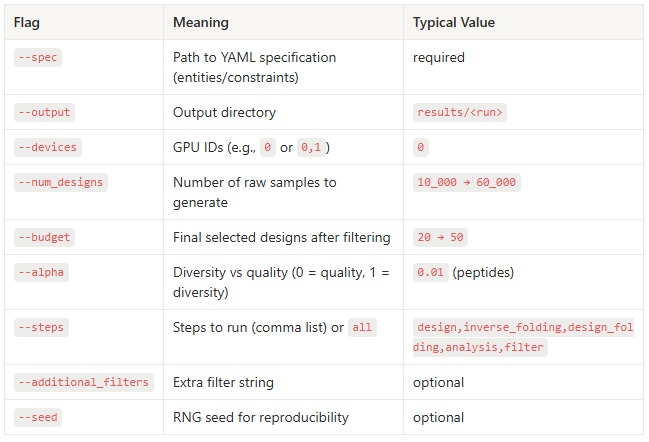
<p>Below protocol is focused, practical guide to run <strong>peptide-anything</strong> on an HPC cluster so anyone can reproduce, tune, and inspect results. It covers YAML examples, key CLI flags, recommended settings, HPC tips, what the outputs mean, and minimal troubleshooting.</p>
<p>BoltzGen samples 3D all-atom structures with virtual placeholders, converts them to sequences (BoltzIF), refolds and scores them (Boltz-2), then ranks/filter designs — peptide-anything constrains the design to short peptide binders.</p>
<h2 id="typical-pipeline-steps-seven-logical-stages">Typical pipeline steps (seven logical stages)</h2>
<ol><li><strong>Design</strong> : diffusion generation of candidate binder structures (BoltzGen core).</li><li><strong>Inverse folding</strong> : generate sequences (BoltzIF).</li><li><strong>Design folding</strong> : refold binder+target to validate interface (Boltz-2).</li><li><strong>Folding :</strong> refold binder alone (for stability; often skipped for short peptides).</li><li><strong>Affinity:</strong> (optional for small molecules) estimate affinity.</li><li><strong>Analysis :</strong> compute interface metrics (buried SASA, H-bonds, salt bridges, plip).</li><li><strong>Filtering :</strong> rank and select diverse, high-quality candidates.</li></ol>
<p>You can run all stages or any subset. For peptides you typically run: design → inverse_folding → design_folding → analysis → filter</p>
<p>Folding-alone can be skipped for very short peptides or nanobodies (default for peptide-anything).</p>
<p><strong>Table 1: Key CLI flags</strong></p>
<figure><img loading="lazy" alt="" src="/assets/images/blogs/boltzgen-from-a-biologists-perspective/6.png" /></figure>
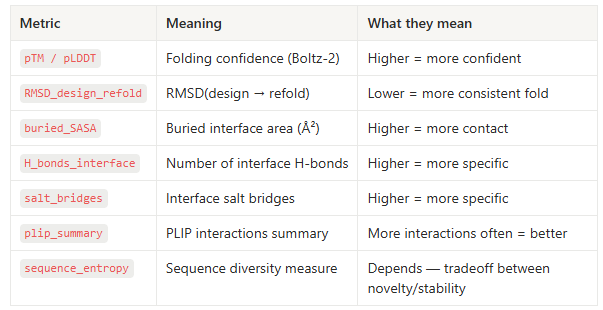
<p><strong>Table 2: Common output metrics</strong></p>
<figure><img loading="lazy" alt="" src="/assets/images/blogs/boltzgen-from-a-biologists-perspective/7.png" /></figure>
<p>Notes:</p>
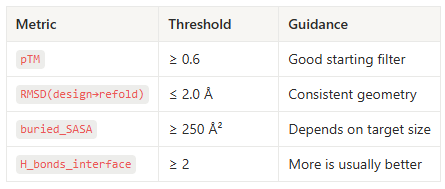
<ul><li><strong>pTM/pLDDT</strong> from Boltz-2 are primary confidence metrics. Use <strong>higher</strong> values for initial triage</li><li><strong>RMSD(design → refold)</strong> close to zero indicates the sequence refolds to the designed geometry, <strong>lower</strong> is better.</li></ul>
<p><strong>Table 3: Design Quality Thresholds</strong></p>
<figure><img loading="lazy" alt="" src="/assets/images/blogs/boltzgen-from-a-biologists-perspective/8.png" /></figure>
<h2 id="minimal-recommended-settings-for-a-first-peptide-run">Minimal recommended settings for a first peptide run</h2>
<ul><li>protocol: peptide-anything</li><li>num_designs: <strong>10,000</strong> (start small) → scale to 30–60k for production.</li><li>budget: <strong>20–50</strong> (final candidates)</li><li>alpha: <strong>0.01</strong> (peptide default)</li><li>steps: design,inverse_folding,design_folding,analysis,filter</li><li>GPUs: ≥16 GB recommended to start; distribute -num_designs across jobs on HPC</li></ul>
<h2 id="conclusion">Conclusion</h2>
<p>BoltzGen works the way structural biology actually works: geometry first. It forces the model to justify every atom, then keeps only the sequences that survive folding, refolding, and the usual structural abuse. Diffusion, inverse folding, and refolding lock together into a single, compact engine that has the leverage to become the baseline for reliable structure generation.</p>
<p>if you love reading about biotech x AI, follow me on twitter/X <a href="https://x.com/TensorTwerker">@TensorTwerker</a> : I share insights on protein modeling, computational biology, and the occasional chaos that happens in my life.</p>]]></content><author><name>Nabajit Borah</name></author><category term="structural-biology" /><category term="diffusion-models" /><category term="computational-biology" /><category term="peptides" /><category term="boltzgen" /><summary type="html"><![CDATA[BoltzGen, a new diffusion model that generates de novo molecules from scratch which binds to other proteins, peptides, nanobodies, disulfide-cyclized peptides, helicons, cyclic peptides, and protein binders for small…]]></summary><media:thumbnail xmlns:media="http://search.yahoo.com/mrss/" url="https://nabajitb.github.io/assets/images/blogs/boltzgen-from-a-biologists-perspective/1.png" /><media:content medium="image" url="https://nabajitb.github.io/assets/images/blogs/boltzgen-from-a-biologists-perspective/1.png" xmlns:media="http://search.yahoo.com/mrss/" /></entry><entry><title type="html">Reprogramming Stem Cells with GPT-4b Micro</title><link href="https://nabajitb.github.io/blogs/reprogramming-stem-cells-with-gpt-4b-micro/" rel="alternate" type="text/html" title="Reprogramming Stem Cells with GPT-4b Micro" /><published>2025-10-23T14:20:05+00:00</published><updated>2025-10-23T14:20:05+00:00</updated><id>https://nabajitb.github.io/blogs/reprogramming-stem-cells-with-gpt-4b-micro</id><content type="html" xml:base="https://nabajitb.github.io/blogs/reprogramming-stem-cells-with-gpt-4b-micro/"><![CDATA[<p><em>Imagine a world where AI doesn’t just write your emails or generate art, it rewrites biology itself.</em></p>
<p>That’s the vision behind a new collaboration between OpenAI and Retro Biosciences, where artificial intelligence is being trained not on language, but on the code of life itself. Unlike traditional language models trained on text and chat logs, this system was trained on protein sequences, 3D structural data, and chemical interaction rules (like how molecules repel, attract, or stick together).</p>
<p>It is a lighter version of GPT-4o designed to understand biology at the molecular level. The team put this model to the test on Yamanaka factors, a Nobel Prize-winning discovery from 2012 that showed how mature cells can be “reprogrammed” back into a stem-cell-like state. The goal wasn’t just to replicate that breakthrough, but to redesign and improve it.</p>
<h2 id="reprogramming-cells-yamanaka-s-nobel-discovery"><strong>Reprogramming Cells: Yamanaka’s Nobel Discovery</strong></h2>
<p>Stem cells are pluripotent, which means, they can differentiate or transform into a very specific role such as heart cells, neurons, immune cells etc. Once a stem cell “chooses” its role, it’s generally locked in for life. A skin cell can’t just decide one day to become a neuron.</p>
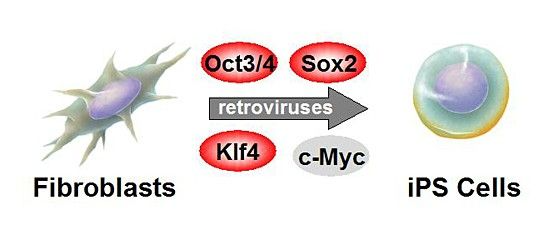
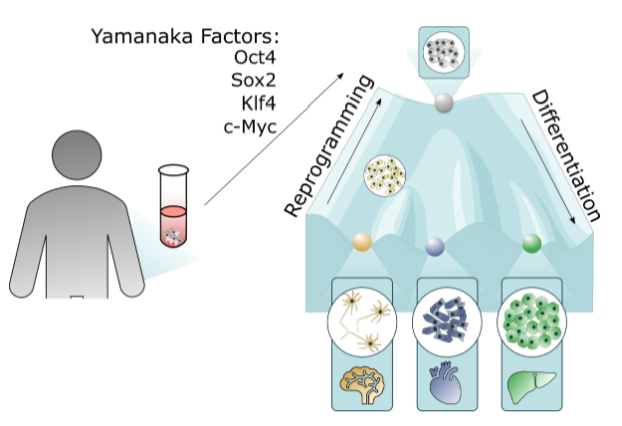
<p>What if we could simply “reprogram” adult, specialized cells back into a youthful state? In 2006, Dr. Shinya Yamanaka showed this was possible. He used just four proteins: Oct3/4, Sox2, Klf4, and c-Myc, now famously known as the Yamanaka factors (or OSKM). These proteins are transcription factors, meaning they bind to DNA and control whether certain genes are turned on or off. Remarkably, by introducing them, Yamanaka was able to reset adult cells into a stem-like state called induced pluripotent stem cells (iPSCs), which behave almost like embryonic stem cells.</p>
<figure><img loading="lazy" alt="" src="/assets/images/blogs/reprogramming-stem-cells-with-gpt-4b-micro/1.png" /><figcaption>Figure 1: OKSM induced via retroviral DNA vector in iPSCs</figcaption></figure>
<p>Why does that matter? Because pluripotent stem cells can:</p>
<ul><li><strong>Self-renew forever </strong>(can keep on making multiple copies of themselves).</li><li><strong>Turn into any cell type</strong> in the human body.</li></ul>
<p>This discovery opened the door to personalized medicine: growing new tissues from a patient’s own cells, organ replacement therapies and even futuristic anti-aging research, all without needing embryos.</p>
<h2 id="the-harsh-reality-of-reprogramming-stem-cells"><strong>The Harsh reality of reprogramming stem cells</strong></h2>
<p>While the idea is groundbreaking, the actual process is a nightmare. Even today, if you try reprogramming cells with the standard recipe, <strong>less than 1 in 1,000 cells makes it to the finish line</strong>. That’s a 0.1% conversion rate. What goes wrong? A lot:</p>
<ul><li>The process is extremely time taking, takes <strong>weeks to months.</strong></li><li>Many cells get stuck halfway, becoming weird “in-between” states which means they are in partially reprogrammed states or undergoing senescence (death).</li><li>And if the cells are from aged donors, the cells just age out and die. A critical limitation for a technology intended to treat age-related diseases.</li></ul>
<p>A cell’s identity is heavily guarded. Think of a skin cell as a laptop with its hard drive locked and encrypted. The Yamanaka factors are like hackers trying to wipe and reinstall the operating system but the firewalls (epigenetic marks like DNA methylation and histone locks) makes it difficult to re-program.</p>
<figure><img loading="lazy" alt="" src="/assets/images/blogs/reprogramming-stem-cells-with-gpt-4b-micro/2.png" /><figcaption>Figure 2: Yamanaka factors reprogram adult cells into stem cells, enabling redifferentiation into various specialized cell types</figcaption></figure>
<p>And that’s not the only hurdle. To truly rewind its state, the cell has to flip its metabolic switch. Mature somatic cells prefer the efficiency of oxidative phosphorylation, while reprogrammed pluripotent cells run on a glycolysis-heavy “youth mode.” This metabolic reshuffling is inherently unstable.<br />Even worse? The process is <strong>unpredictable</strong>. Every batch of cells acts differently, which makes it almost impossible to meet the strict quality standards needed for medical use.</p>
<h2 id="why-sox2-and-klf4-are-central-to-the-study">Why SOX2 and KLF4 are central to the study?</h2>
<p>Among the four factors, SOX2 and KLF4 are the real MVPs. They’re the pioneer transcription factors.</p>
<p>Normally, DNA is wound up tightly like a locked book. Most proteins can’t even touch it unless the book is open. But SOX2 and KLF4 are special, they can crack open that locked DNA, making space for the other factors (like OCT4) to swoop in and activate the stem cell program.</p>
<p>What if we could tweak SOX2 and KLF4 to work better, the entire reprogramming process might become faster and more reliable. That’s what researchers at OpenAI and Retro Biosciences asked. But proteins are insanely complicated to tweak. Each is a long chain of hundreds of amino acids, and the number of possible folding combinations for a protein to work correctly.</p>
<h2 id="gpt-4b-micro-teaching-ai-the-language-of-proteins">GPT-4b Micro: Teaching AI the Language of Proteins</h2>
<p>This is essentially a <strong>specialized adaptation of GPT-4o</strong>, scaled down and fine-tuned for biology. Instead of learning from human text, the model is trained on massive protein databases like UniProt, which contain hundreds of millions of sequences. The model begins to capture <strong>deep contextual relationships between amino acids</strong>, almost like how a language model captures grammar and meaning in human languages.It learns not just the “what” (sequence) but also the “how” (structure), “where” (interaction network), and “why” (functions described).</p>
<p>One of the standout features here is the <strong>exceptionally large context window of 64,000 tokens</strong>. For protein language models (PLMs), where each token can represent a single amino acid, this scale is enormous. It means the model isn’t just limited to analyzing short fragments or local motifs; it can take in the <strong>entire protein sequence at once</strong>, along with its <strong>interaction partners</strong> and even <strong>functional annotations</strong>, all within a single pass.</p>
<p>This capability fundamentally changes how the model “thinks” about proteins. Instead of treating them as disjointed stretches of local patterns, the PLM can reason about the protein as a <strong>complete functional entity,</strong> capturing long-range dependencies, domain–domain interactions, and even context-dependent regulatory patterns that would be invisible to smaller models.</p>
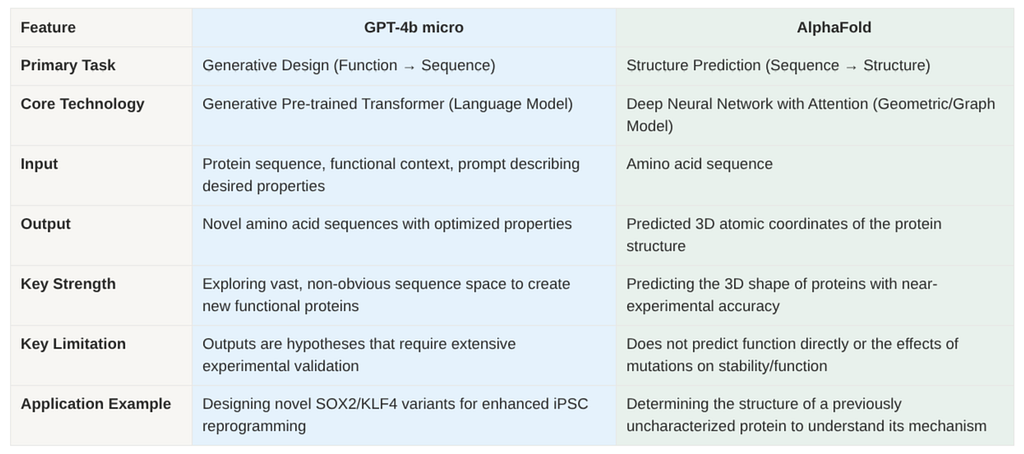
<p>While GPT-4b Micro brings a new way of reasoning about proteins, it’s easy to confuse its role with existing models. The most famous example is Google’s AlphaFold. So how do they differ?</p>
<h2 id="gpt-4b-micro-vs-alphafold-prediction-vs-generation">GPT-4b Micro vs. AlphaFold: Prediction vs. Generation</h2>
<ul><li>To simply put, <strong>AlphaFold is a predictive model</strong>. It brilliantly solves the “protein folding problem,” taking a linear amino acid sequence as input and predicting its complex 3D structure with experimental accuracy.</li><li><strong>GPT-4b micro is a generative model</strong>. It tackles the “protein design problem,” taking a desired function as an input (via prompting) and generating novel amino acid sequences predicted to fulfill that function.</li></ul>
<figure><img loading="lazy" alt="" src="/assets/images/blogs/reprogramming-stem-cells-with-gpt-4b-micro/3.png" /><figcaption>Table 1: Comparative Analysis of GPT-4b micro vs. AlphaFold</figcaption></figure>
<p>Before diving into the reprogramming workflow itself, it’s important to ask: <strong>how do scientists actually know when the reprogramming has worked?</strong></p>
<h2 id="molecular-markers-of-pluripotency"><strong>Molecular Markers of Pluripotency</strong></h2>
<p>The answer is in <strong>molecular markers, distinct signals that appear at different stages of the process</strong>, revealing whether a cell is truly on its way to becoming an induced pluripotent stem cell (iPSC).</p>
<ul><li><strong>Early Markers</strong>: The appearance of <strong>SSEA-4</strong>, a surface molecule, is one of the first signs that reprogramming has begun.</li><li><strong>Late Markers</strong>: A fully reprogrammed cell is confirmed by markers such as <strong>TRA-1–60</strong> (surface antigen) and <strong>NANOG</strong> (a transcription factor essential for maintaining pluripotency).</li><li><strong>Visual Confirmation</strong>: Staining the reprogrammed cells with <strong>Alkaline Phosphatase (AP)</strong>, where pluripotent colonies light up in red or purple, providing a quick visual check of successful reprogramming.</li></ul>
<p>Together, these markers give both <strong>molecular and visual proof</strong> that cells have crossed the threshold into pluripotency and the experiment is a success.</p>
<h2 id="the-workflow">The Workflow</h2>
<p>Broadly, the entire workflow can be divided into the following steps:</p>
<p><strong>A. Retro’s High-Throughput Screening Engine</strong></p>
<p>Computationally proteins are just hypotheses until they’re stress-tested in cells. The group at Retro Biosciences implemented a <strong>high‑throughput screening pipeline</strong> in human fibroblasts and used it to benchmark baseline OSKM alongside SOX2 variants manually designed in a pilot. This setup created a crucial <strong>feedback loop</strong>: AI proposes new protein designs, the lab rapidly tests them, and the results flow back to refine the next round of designs.</p>
<p><strong>B. Designing RetroSOX and RetroKLF</strong></p>
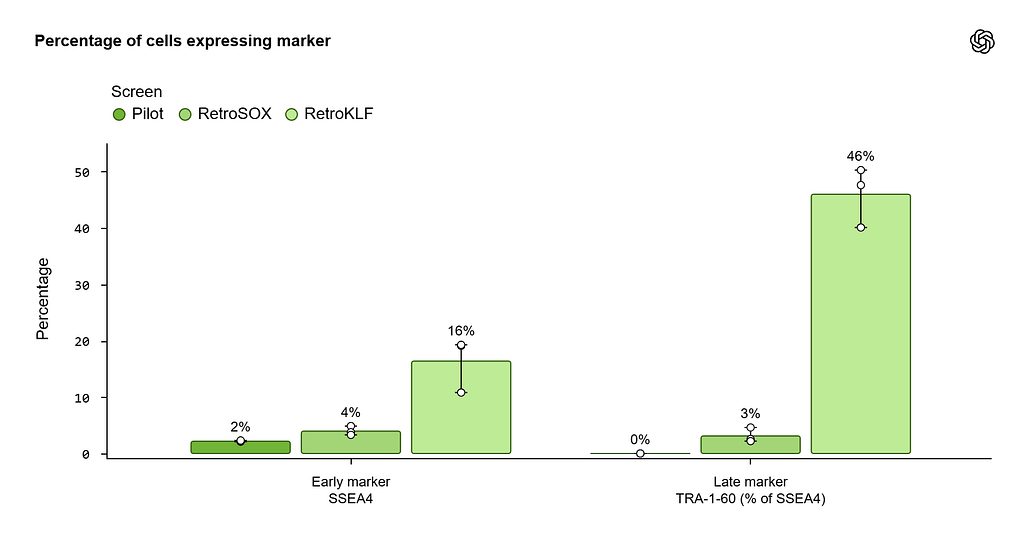
<p>The engineering process began with prompting GPT-4b micro to generate a diverse panel of SOX2 (“RetroSOX”) and KLF (”RetroKLF’) designs.</p>
<figure><img loading="lazy" alt="" src="/assets/images/blogs/reprogramming-stem-cells-with-gpt-4b-micro/4.png" /><figcaption>Figure 3: This bar plot compares three screening sets: Pilot (standard OSKM/control), RetroSOX, and RetroKLFon</figcaption></figure>
<ul><li>Early marker (SSEA‑4): Pilot ~2–4%; RetroSOX climbs to ~16%.</li><li>Late marker (TRA‑1‑60): Pilot ~0%; RetroSOX ~3%; RetroKLF jumps dramatically to ~46%.</li></ul>
<p>AI‑designed variants push more cells into early pluripotency and, crucially, accelerate maturation to late markers.</p>
<p><strong>C. Unprecedented Hit Rates</strong></p>
<p>The results generated are remarkable</p>
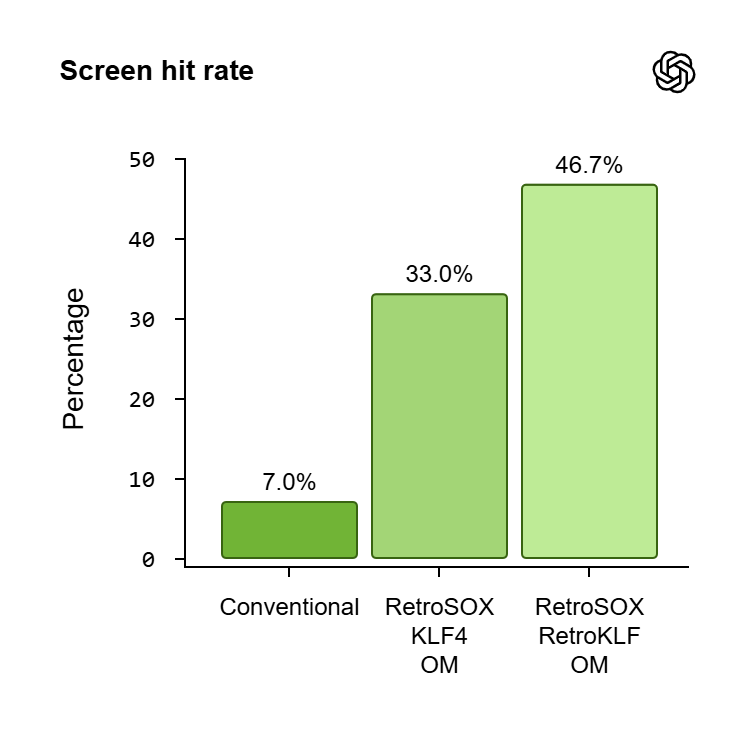
<ul><li>For <strong>RetroSOX</strong>, the engineered variants of SOX2, over 30% of the designs tested showed superior performance compared to the wild-type protein in inducing pluripotency markers.</li><li>For <strong>RetroKLF</strong>, the results were even more striking, with a hit rate approaching 50%</li></ul>
<figure><img loading="lazy" alt="" src="/assets/images/blogs/reprogramming-stem-cells-with-gpt-4b-micro/5.png" /><figcaption>Figure 4: Illustrates how AI outperforms traditional methods in protein engineering. On the left, it’s about hit rates, how many designed variants outperform the natural protein</figcaption></figure>
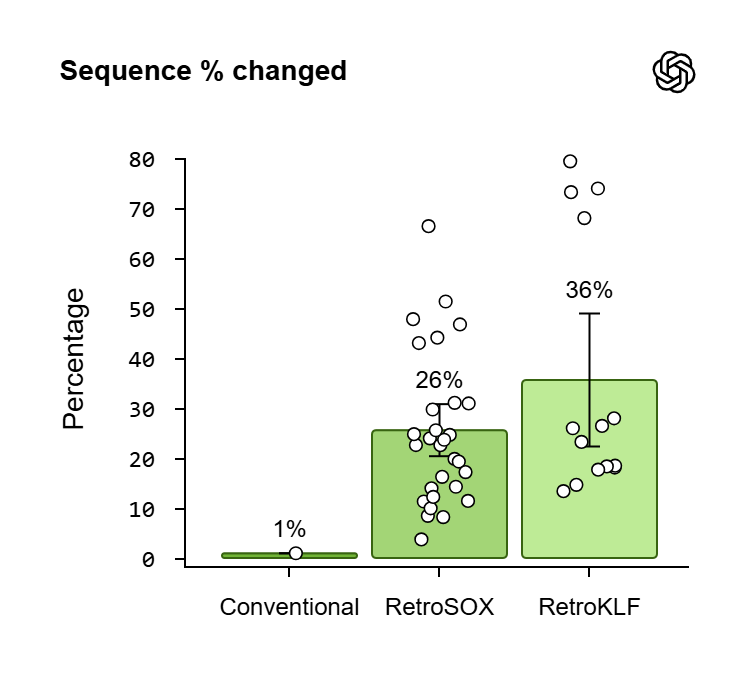
<figure><img loading="lazy" alt="" src="/assets/images/blogs/reprogramming-stem-cells-with-gpt-4b-micro/6.png" /><figcaption>Figure 5: Reveals the scale of changes: traditional designs changes only ~1% of amino acids, but RetroSOX averages ~26% change and RetroKLF ~36%, with a spread of diverse edits shown in the scatter.</figcaption></figure>
<p><strong>D. What Happens When You Combine the Winners</strong></p>
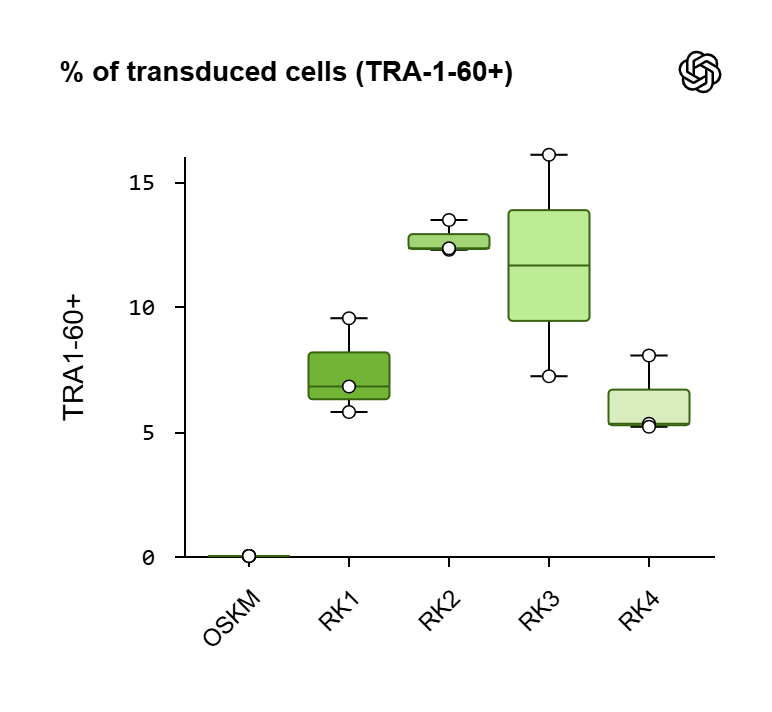
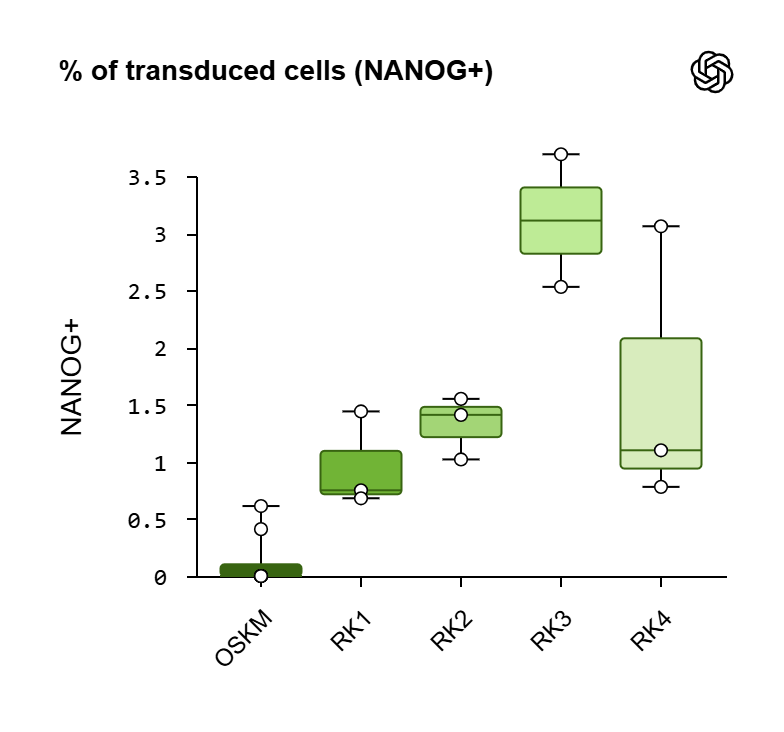
<p>When the top-performing RetroSOX and RetroKLF variants were combined in the reprogramming cocktail. Across multiple independent experiments, this combination led to a synergistic effect, producing a dramatic and rapid increase in the expression of both early (SSEA-4) and late-stage (TRA-1–60, NANOG) pluripotency markers. The improvement was not just in the final yield but also in the speed of the process.</p>
<figure><img loading="lazy" alt="" src="/assets/images/blogs/reprogramming-stem-cells-with-gpt-4b-micro/7.png" /><figcaption>Figure 6: Increased in detection of late stage marker TRA-1–60</figcaption></figure>
<figure><img loading="lazy" alt="" src="/assets/images/blogs/reprogramming-stem-cells-with-gpt-4b-micro/8.png" /><figcaption>Figure 7: Increased in detection of late stage marker NANOG</figcaption></figure>
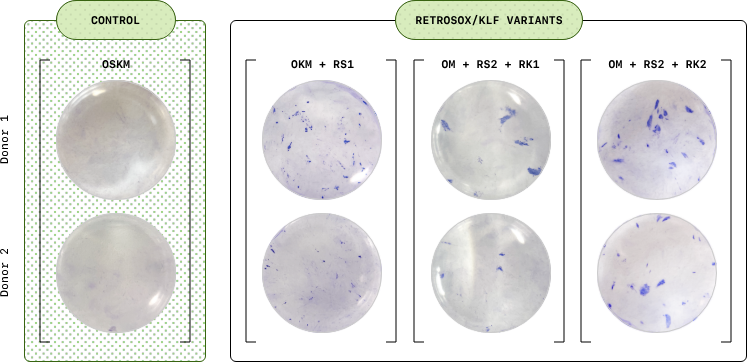
<figure><img loading="lazy" alt="" src="/assets/images/blogs/reprogramming-stem-cells-with-gpt-4b-micro/9.png" /><figcaption>Figure 8: Alkaline Phosphate (AP) staining validation. Purple colonies indicate successful reprogramming</figcaption></figure>
<p>Visual confirmation through AP staining confirms these findings, revealing the formation of numerous, large, and well-defined iPSC colonies, providing clear evidence of a hyper-efficient reprogramming greater than a 50-fold higher expression of AI-engineered variants.</p>
<p><strong>Maintaining DNA integrity is a core hallmark of aging</strong></p>
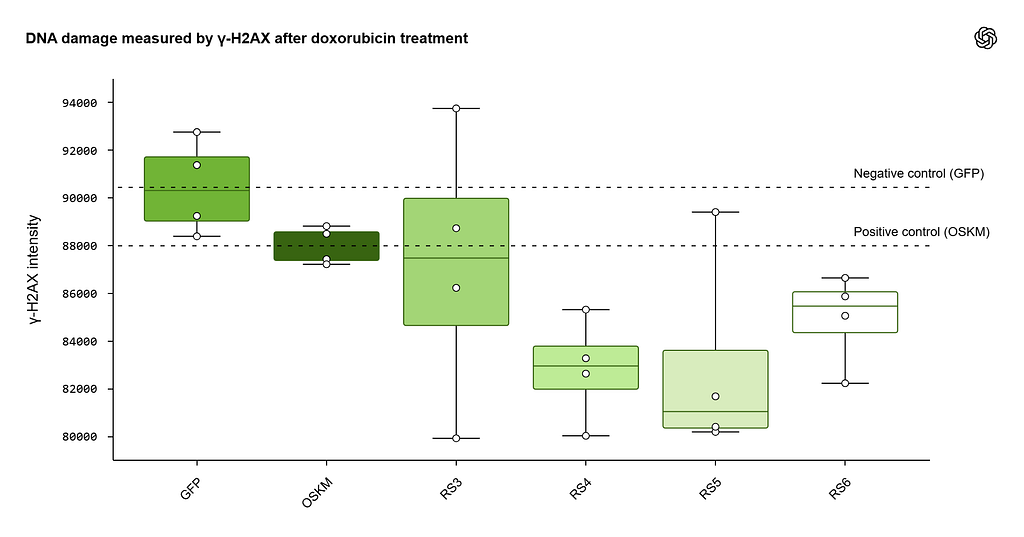
<p>One of the main reasons cells age is the buildup of <strong>DNA damage</strong>. When DNA strands break, especially <strong>double-strand break</strong>s, the cell’s ability to function declines. A protein marker called <strong>γ-H2AX lights up at these breaks</strong>, allowing scientists to measure how much damage has occurred.</p>
<p>Human cells exposed to the <strong>chemotherapy drug doxorubicin </strong>(which induces DNA breaks) were reprogrammed with different factor combinations. The <strong>RetroSOX/KLF cocktail led to much lower γ-H2AX levels compared to the original Yamanaka factors (OSKM) or controls</strong>. In simple terms, these engineered factors helped cells repair their DNA more effectively.</p>
<figure><img loading="lazy" alt="" src="/assets/images/blogs/reprogramming-stem-cells-with-gpt-4b-micro/10.png" /><figcaption>Figure 9: DNA damage (measured by the marker γ-H2AX) remained in cells after being stressed with the chemotherapy drug doxorubicin.</figcaption></figure>
<ul><li><strong>GFP (negative control)</strong>: High γ-H2AX levels, means, lots of unrepaired DNA damage.</li><li><strong>OSKM (positive control)</strong>: Slight improvement, but still elevated damage.</li><li><strong>RetroSOX/KLF variants (RS3 — RS6)</strong>: RS4 and RS5, which showed the lowest DNA damage levels, suggesting AI-engineered factors can help cells repair breaks more effectively.</li></ul>
<h2 id="limitation-and-the-road-ahead"><strong>Limitation and the road ahead</strong></h2>
<p>Despite the impressive results, this is still early-stage science. Clinical stages requires Gold Standard efficiency and safety. Some of the key limitations includes:</p>
<ul><li><strong>Scalability</strong>: High-throughput screening in fibroblasts is promising but does not yet guarantee success in large-scale manufacturing environments.</li><li><strong>Long-Term Safety</strong>: While genomic stability was confirmed in early passages, extended culture and in vivo studies are needed to rule out subtle mutations or tumorigenicity risks.</li><li><strong>Cell type dependent</strong>: Validation was performed in fibroblasts and MSCs; generalizability across other cell types remains to be established.</li><li><strong>Reproducibility</strong>: Independent replication by external labs will be necessary to strengthen confidence in the findings.</li><li><strong>Access and Transparency</strong>: The model, GPT-4b Micro, was developed internally for research and is not broadly available. <strong>The project was a collaboration between OpenAI’s research team and Retro Biosciences, in which Sam Altman is an investor</strong>.</li></ul>
<p>if you love reading about biotech x AI, follow me on twitter/X <a href="https://x.com/TensorTwerker">@TensorTwerker</a> : I share insights on protein modeling, computational biology, and the occasional chaos that happens in my life.</p>]]></content><author><name>Nabajit Borah</name></author><category term="stem-cells" /><category term="openai" /><category term="biotechnology" /><category term="generative-ai-tools" /><category term="ai" /><summary type="html"><![CDATA[Imagine a world where AI doesn’t just write your emails or generate art, it rewrites biology itself. That’s the vision behind a new collaboration between OpenAI and Retro Biosciences, where artificial intelligence is…]]></summary><media:thumbnail xmlns:media="http://search.yahoo.com/mrss/" url="https://nabajitb.github.io/assets/images/blogs/reprogramming-stem-cells-with-gpt-4b-micro/1.png" /><media:content medium="image" url="https://nabajitb.github.io/assets/images/blogs/reprogramming-stem-cells-with-gpt-4b-micro/1.png" xmlns:media="http://search.yahoo.com/mrss/" /></entry></feed>